Cross-Genre Skill Migration in Racing, Action, and Strategy Video Games
Written by Otto Hughes · Aug 16, 2026
Cross-Genre Skill Migration in Racing, Action, and Strategy Video Games
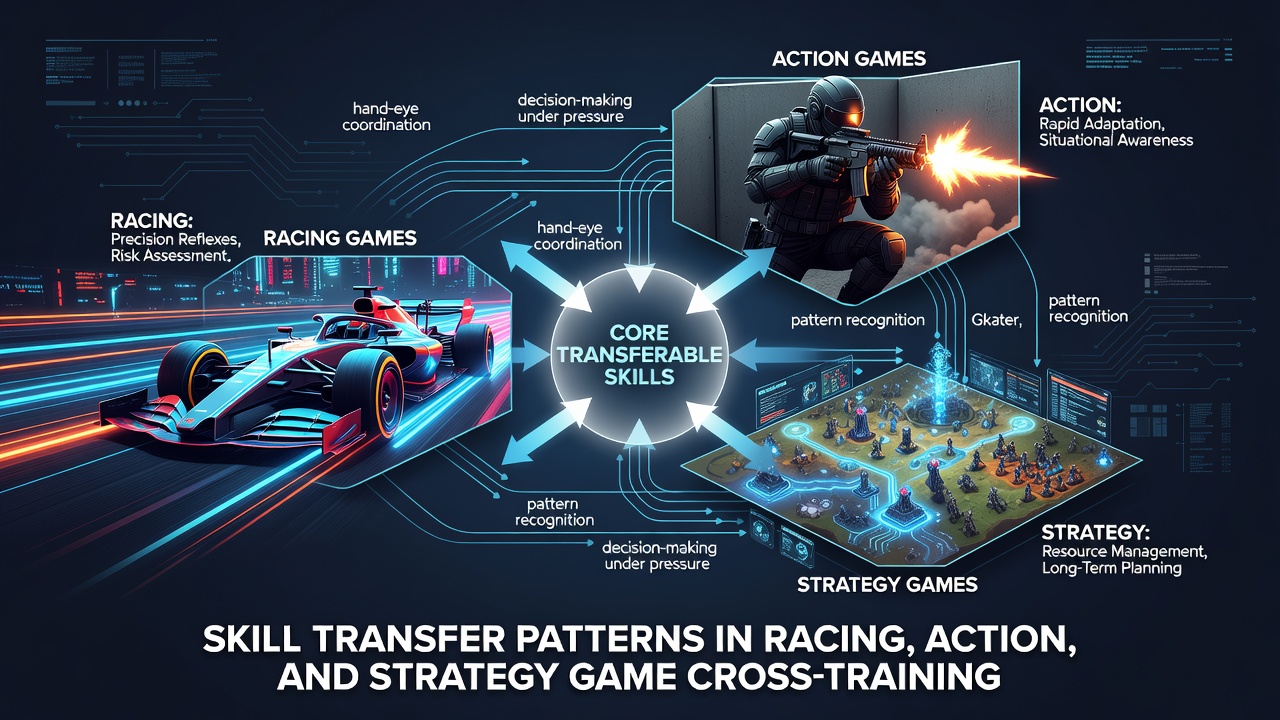
Studies in cognitive psychology and human-computer interaction have tracked how abilities developed through repeated play in one genre migrate to performance in others, and researchers continue to map these pathways across racing, action, and strategy titles. Data collected through August 2026 shows measurable overlaps in reaction timing, spatial reasoning, and resource allocation that appear when players rotate between genres during extended training periods. Observers note that the transfer occurs most reliably when core mechanics share underlying cognitive demands rather than surface-level similarities.
Core Mechanisms Behind Genre-Spanning Transfer
Reaction latency trained in fast-paced action sequences often reduces lap times in racing simulations because both require precise timing under visual load, while the same players demonstrate improved unit placement in strategy games after practicing quick target acquisition in shooters. According to findings published by the Entertainment Software Association, sessions that alternate between high-speed navigation and tactical planning produce faster adaptation rates than single-genre regimens. The shared demand on working memory appears to strengthen the neural pathways used for predictive modeling, allowing skills to compound across seemingly unrelated interfaces.
Racing-to-Action Carryover Patterns
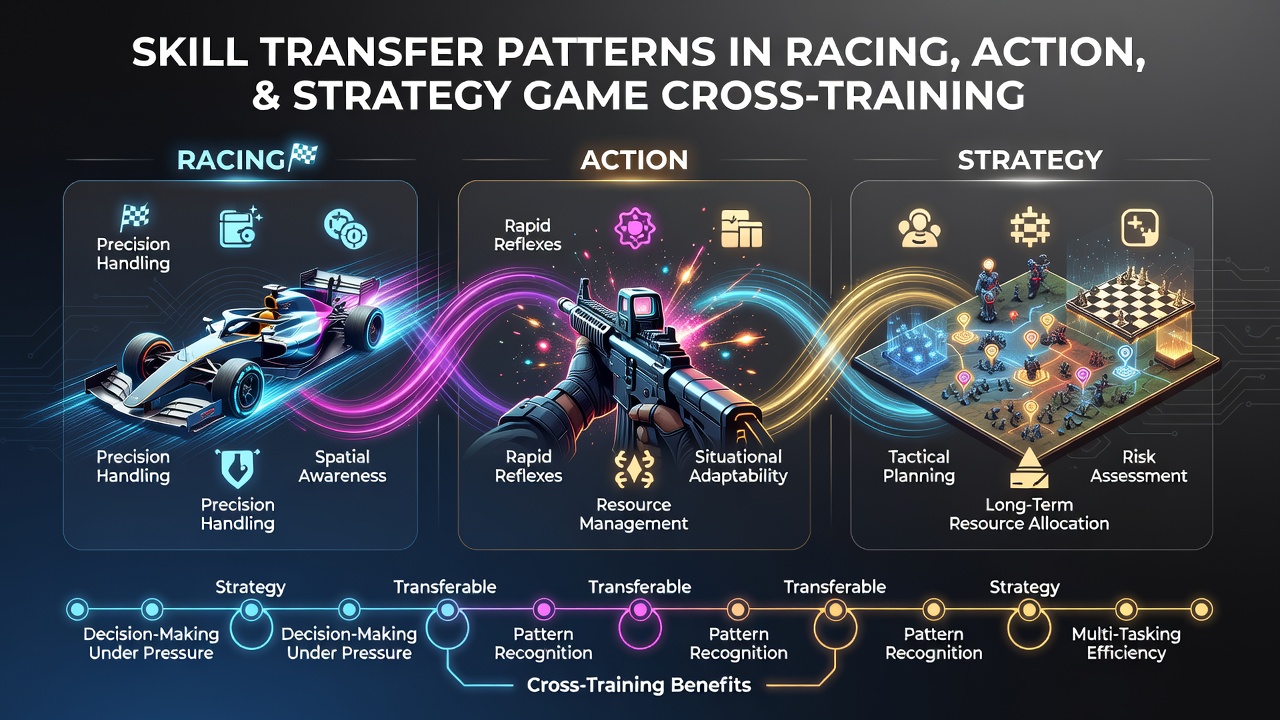
Drivers who log extensive hours in simulation racers frequently record higher accuracy in action titles that emphasize trajectory prediction and obstacle avoidance, and the effect strengthens when both game types include variable physics models. Those who study telemetry data from professional esports teams report that braking-point calculation in racing correlates with grenade arc estimation in first-person shooters, suggesting a common reliance on parabolic motion intuition. Extended cross-training blocks of four to six weeks produce the largest gains, after which diminishing returns set in unless difficulty curves continue to escalate.
Action-to-Strategy and Strategy-to-Racing Pathways
Action-game veterans often show accelerated build-order optimization once they enter real-time strategy environments, because the rapid target prioritization learned in combat scenarios transfers directly to threat assessment on the minimap. Strategy players, conversely, bring improved route-planning efficiency to racing circuits after mastering multi-front resource management, and this advantage appears most pronounced in endurance events that reward consistent pacing over raw speed. Figures released by the GamesIndustry.biz research division indicate that mixed-genre cohorts achieve 12 to 18 percent better consistency scores than control groups limited to one category.
Measurement Approaches and Recent Data Trends
Researchers quantify transfer through pre- and post-test batteries that isolate variables such as cornering precision, flick-shot accuracy, and build-timing variance, then track how scores evolve after controlled rotation schedules. Longitudinal observations through mid-2026 reveal that players who interleave genres every 45 to 60 minutes retain higher overall engagement metrics and exhibit lower performance decay during long sessions. Eye-tracking studies further confirm that gaze patterns developed in racing cockpits migrate to action aiming reticles and strategy overview screens, supporting the claim that visual attention strategies generalize more readily than motor programs alone.
Limitations and Boundary Conditions
Transfer remains bounded by hardware differences and input-device familiarity, so keyboard-and-mouse strategy skills translate less cleanly to wheel-based racing than to controller-based action titles. Age-related declines in processing speed also moderate the magnitude of carryover, with younger cohorts showing steeper initial gains. Observers emphasize that deliberate practice schedules, rather than casual rotation, determine whether measurable transfer occurs at all.
Conclusion
Skill transfer across racing, action, and strategy genres follows predictable patterns rooted in shared cognitive demands on timing, spatial prediction, and resource allocation. Data gathered through August 2026 continues to refine the boundaries of these effects, and training programs that exploit the documented overlaps produce measurable performance uplifts in each domain when rotation intervals and difficulty progression are calibrated appropriately.