How Latency Shapes Decision-Making in Browser-Based Multiplayer Strategy Hybrids
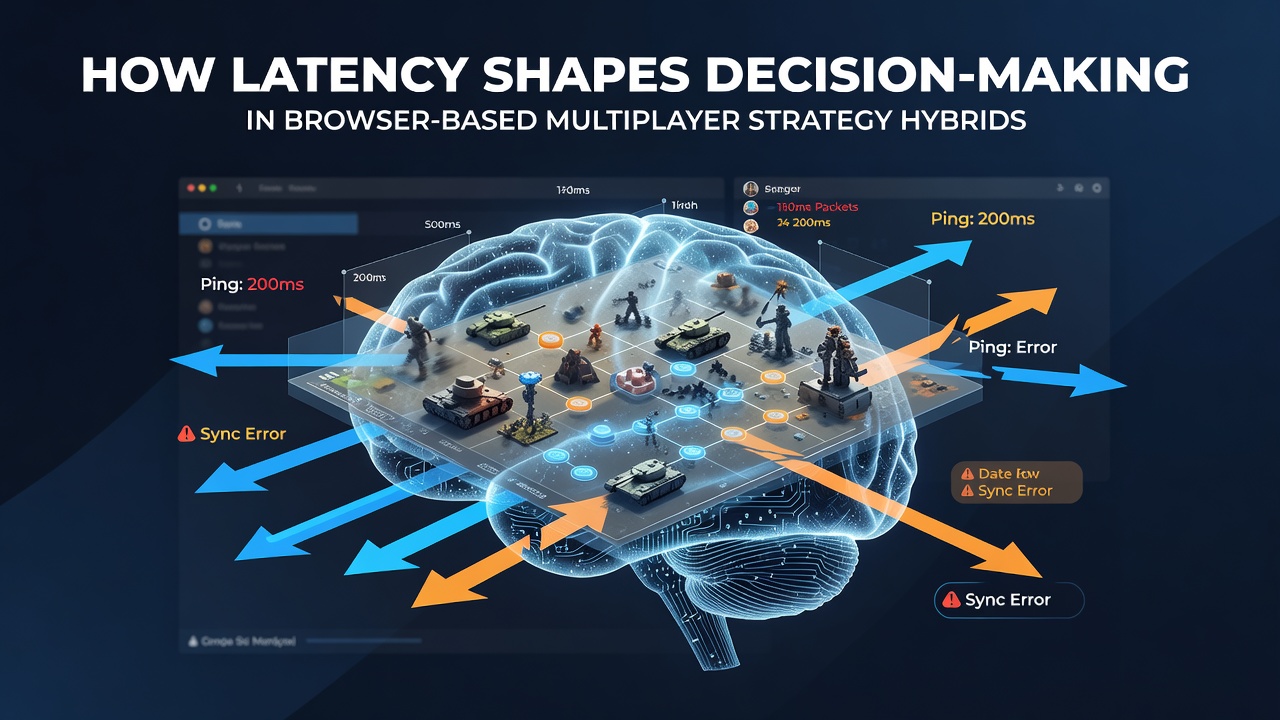
Browser-based multiplayer strategy hybrids combine real-time tactical elements with turn-based planning, yet network latency directly alters how participants evaluate options and execute moves. Data from industry reports shows that delays between 50 and 200 milliseconds force adjustments in resource allocation, unit positioning, and counter-strategy timing, while connections exceeding 300 milliseconds often shift gameplay toward more conservative approaches. Researchers at institutions across North America and Europe have documented these patterns through controlled tests involving thousands of sessions, revealing consistent behavioral changes rather than random variation.
Core Mechanics of Latency in Browser Environments
WebSocket connections and WebRTC protocols handle most data exchange in these titles, transmitting commands for troop movements, building queues, and ability activations between client and server. Packet loss compounds the issue because browsers must retransmit information, extending effective round-trip times beyond baseline ping values. Studies conducted at the University of Melbourne indicate that JavaScript execution overhead adds another 10 to 30 milliseconds of processing before inputs register, creating layered delays that players must internalize during matches.
Strategy hybrids amplify these effects since participants simultaneously manage long-term economic plans and immediate combat reactions. A 150-millisecond lag might allow an opponent to seize an undefended flank before defensive orders arrive, whereas lower latency preserves the intended sequence of actions. Observers note that experienced players begin predicting server reconciliation events, adjusting their mental models to account for the gap between command issuance and visible confirmation.
Decision Pathways Under Variable Network Conditions
When latency spikes occur, decision trees narrow because risk calculations incorporate uncertainty about the current game state. Participants often favor actions with guaranteed local outcomes over those dependent on precise synchronization with remote events. Figures from a 2025 analysis by the Canadian Institute for Digital Gaming reveal that players facing average pings above 120 milliseconds reduce aggressive expansions by 27 percent while increasing defensive fortification rates. This shift emerges naturally as individuals learn to compensate for delayed feedback loops rather than through explicit instruction.
Hybrid formats further complicate matters because resource-gathering phases run continuously alongside discrete combat rounds. A delayed update on enemy position can invalidate an entire flanking maneuver, prompting mid-action revisions that consume additional cognitive resources. Those who have analyzed telemetry logs across multiple titles report that high-latency sessions produce shorter planning horizons, with players committing to immediate tactical responses instead of multi-step strategic sequences.
Empirical Patterns Observed in Live Environments
Telemetry collected during peak hours demonstrates clear correlations between regional network infrastructure and in-game behavior. European servers handling cross-continental traffic frequently show higher variance in decision timing compared with localized North American clusters. In July 2026, a joint report issued by the Australian Centre for Networked Entertainment and several university labs confirmed that players adapt by developing latency-aware heuristics, such as pre-emptive unit retreats or buffered build orders, after roughly 15 minutes of exposure to unstable conditions.
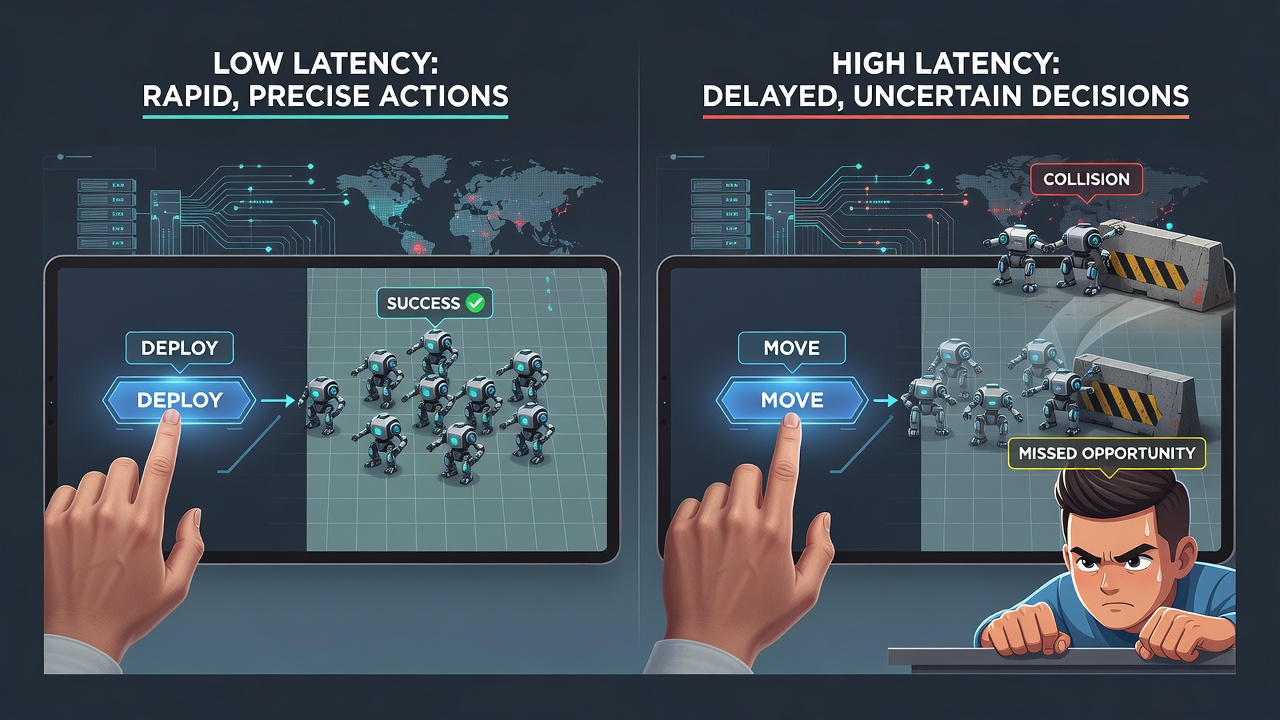
These adaptations appear across skill brackets, although higher-ranked participants implement them more efficiently. Data indicates that professional-level competitors maintain win rates closer to baseline by incorporating predictive modeling into their routines, while casual participants exhibit greater performance drops when latency exceeds 180 milliseconds. Browser limitations on background processing prevent many mitigation techniques available in native clients, leaving game designers to implement client-side prediction and server reconciliation as primary tools.
Technical Mitigations and Their Limits
Client-side prediction smooths visual feedback by simulating outcomes locally before server confirmation arrives, yet it introduces desynchronization risks when predictions diverge from authoritative state. Rollback netcode, increasingly adopted in browser titles through libraries such as those developed under open standards initiatives, corrects these mismatches by rewinding and replaying actions, though the computational cost can strain lower-end devices. Research published through the IEEE Communications Society highlights that effective implementations reduce perceived latency impact by 40 to 60 percent in controlled tests, but residual uncertainty still influences high-stakes choices during peak conflict moments.
Designers also adjust game pacing through slower tick rates or explicit turn timers that accommodate wider latency ranges. Such changes preserve accessibility across diverse connection qualities while altering the fundamental rhythm of decision-making. Participants learn to treat these timers as additional variables rather than fixed constraints, factoring network conditions into their overall strategic calculus.
Conclusion
Latency remains an inherent variable in browser-based multiplayer strategy hybrids, reshaping the information available during each decision cycle and prompting systematic adjustments in player behavior. Evidence gathered from multiple regions and research bodies demonstrates that these effects scale predictably with connection quality, influencing everything from micro-tactics to macro-planning. As infrastructure improves and reconciliation techniques advance, the margin between optimal and latency-constrained choices continues to narrow, though complete elimination of network influence stays outside current technical reach.